
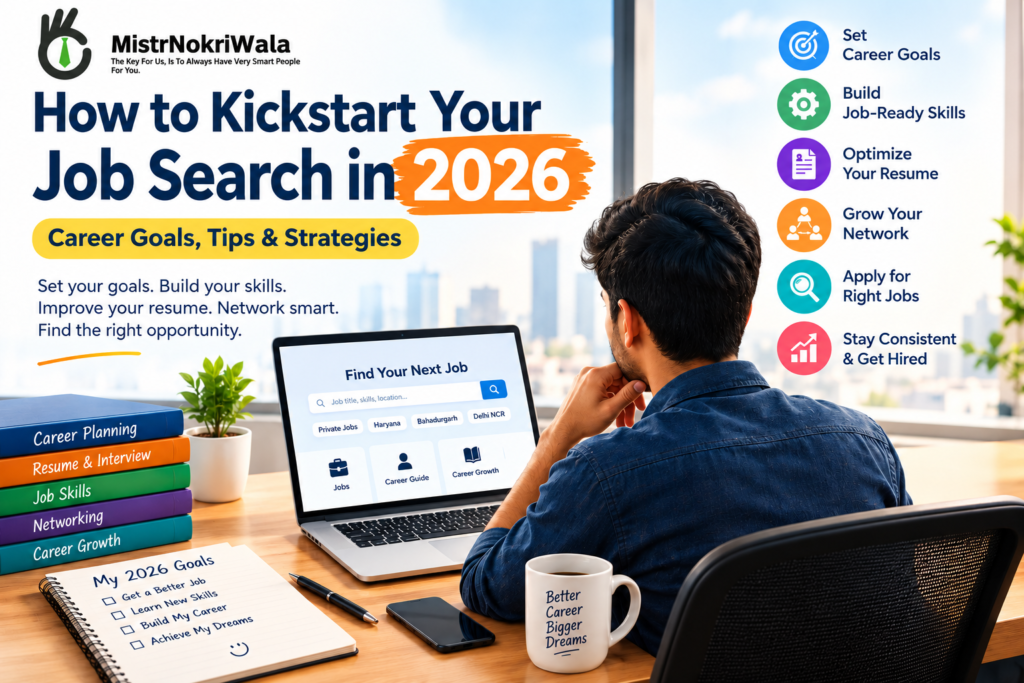
A new year is a good opportunity to take a fresh look at your career, evaluate your progress, and decide what you want to achieve next. If you are searching for a new job, planning a career switch, trying to move into a better role, or simply looking for better career growth, having a clear strategy can make your job search more focused and effective.
In 2026, simply sending the same resume to dozens of companies may not be enough. Job seekers need to understand their career goals, build relevant skills, create a strong resume, use professional networking effectively, prepare for interviews, and apply for the right opportunities.
In this guide, we will discuss practical job search strategies for 2026 that can help you become more organized, improve your employability, and move closer to your next career opportunity.
1. Start by Reviewing Your Career Journey
Before deciding where you want to go, take some time to understand where you are today.
Whether you are a fresher, an experienced professional, or someone planning a career change, reviewing your previous year can help you identify your strengths, weaknesses, achievements, and areas that need improvement.
Ask yourself:
- What were my biggest professional achievements?
- What new skills did I learn?
- Which responsibilities did I perform well?
- What challenges did I face?
- What mistakes can I learn from?
- What type of work did I enjoy?
- What kind of role do I want next?
- What skills do I need to develop to reach that role?
This simple exercise can help you avoid applying randomly for every available vacancy.
Instead, you can build your job search around a clear career direction.
Define the Type of Job You Want
For example, instead of setting a general goal such as:
“I want to get a good job.”
make your goal more specific:
“I want to start my career in digital marketing.”
or:
“I want to move from an accounts executive position to an accountant role with better responsibilities and salary.”
A specific goal makes it easier to decide which jobs to apply for, which skills to develop, and what kind of resume to create.
2. Set Clear Career Goals for 2026
Once you understand your current position, the next step is to establish clear career goals for 2026.
One useful approach is to create SMART career goals. SMART stands for:
- Specific
- Measurable
- Achievable
- Relevant
- Time-bound
For example, instead of saying:
“I want to improve my career.”
you could set a goal such as:
“I will complete a practical digital marketing learning plan within three months and apply for relevant entry-level positions after building a portfolio.”
Similarly, an experienced job seeker might set a goal such as:
“I will apply to five relevant jobs every week and improve my resume based on the requirements of the positions I am targeting.”
Break Your Career Goal Into Smaller Targets
A large career goal can feel overwhelming. Breaking it into smaller actions makes it easier to maintain consistency.
For example:
Career Goal: Get a better job in 2026.
Monthly targets:
- Improve your resume
- Update your professional profile
- Identify suitable job roles
- Learn one relevant skill
- Apply for relevant vacancies regularly
- Prepare for interviews
- Track applications and responses
The objective is not to apply to the maximum number of jobs.
The objective is to make better applications consistently.
3. Build Job-Ready Skills for Your Target Role
The job market continues to change, and employers often look for candidates who can demonstrate practical skills rather than simply listing qualifications.
This does not mean you need to learn everything.
Instead, identify the skills that are actually relevant to the job you want.
For example:
For Accounts & Finance Roles
You may need skills related to:
- Accounting fundamentals
- Tally or accounting software
- MS Excel
- GST and basic taxation knowledge
- Financial reporting
- Data accuracy and documentation
For Sales & Business Development Roles
Useful skills may include:
- Communication
- Lead generation
- Customer handling
- Negotiation
- Follow-ups
- CRM tools
- Sales reporting
For Digital Marketing Roles
Relevant skills can include:
- SEO
- Social media management
- Content marketing
- Search engine marketing
- Analytics
- Email marketing
- Basic design and content creation
The important point is to match your learning with your target job profile.
Learning a skill without understanding how it is used in the workplace may not significantly improve your job prospects.
4. Make Your Resume Ready for 2026 Job Applications
Your resume is often one of the first things a recruiter sees when you apply for a position.
A strong resume should quickly communicate:
Who you are → What you can do → What experience you have → Why you are suitable for the role.
Tailor Your Resume to the Job
Avoid using exactly the same resume for every position.
Read the job description carefully and identify:
- Required skills
- Educational qualifications
- Experience requirements
- Software/tools mentioned
- Responsibilities
- Industry-specific terms
Then highlight the relevant experience and skills in your resume.
Use Relevant Keywords Naturally
Many companies use Applicant Tracking Systems (ATS) or other digital recruitment processes to organize and screen applications.
Therefore, if a job description specifically requires MS Excel, Tally, lead generation, SEO, CRM, or customer handling, and you genuinely possess those skills, make sure they are clearly mentioned in your resume.
However, avoid adding keywords simply to manipulate an ATS.
Your resume should accurately represent your actual skills and experience.
Focus on Achievements, Not Just Responsibilities
Compare:
Weak:
Responsible for sales and customer handling.
Better:
Managed customer follow-ups and contributed to monthly sales targets through regular lead conversion activities.
Whenever possible, use measurable results that you can genuinely support.
Keep Your Resume Easy to Read
A recruiter should be able to understand your profile quickly.
Use:
- Clear headings
- Short bullet points
- Relevant skills
- Consistent formatting
- Recent and relevant experience
- Accurate contact information
Avoid filling your resume with unnecessary information that does not support your target role.
5. Use Professional Networking to Discover More Opportunities
Job searching is not only about visiting job portals and clicking the Apply button.
Professional networking can also help you discover opportunities, learn about industries, and connect with people working in your target field.
You can:
- Keep your LinkedIn profile updated
- Connect with professionals in your target industry
- Follow companies you want to work for
- Participate in relevant professional communities
- Attend career events and webinars
- Speak with former colleagues and professional contacts
- Ask experienced professionals for career advice
Networking does not mean asking every person for a job.
Instead, focus on building genuine professional relationships.
A useful connection today may become a source of career advice, a referral, or an opportunity in the future.
6. Search for the Right Jobs Instead of Applying Everywhere
One of the biggest mistakes job seekers make is applying to almost every vacancy they see.
A better approach is to identify the jobs that actually match your:
- Qualification
- Skills
- Experience
- Location preference
- Salary expectations
- Career goals
For example, if you are looking for private jobs in Haryana, you can narrow your search based on locations such as Bahadurgarh, Rohtak, Jhajjar, Sonipat, Panipat and nearby areas.
You can also search by job profile, such as:
- Accountant
- Sales Executive
- Business Development Executive
- HR Executive
- Data Entry Operator
- Digital Marketing Executive
- Receptionist
- Production Executive
- Quality Executive
This makes your job search more focused and reduces the time you spend applying for unsuitable positions.
Explore Current Job Opportunities
If you are actively looking for private-sector opportunities, you can explore the latest vacancies on MistrNokriWala and filter opportunities according to your requirements.
7. Create a Simple Job Application Tracking System
When you apply for many jobs, it is easy to forget:
- Which company you applied to
- Which position you applied for
- When you applied
- Whether the recruiter contacted you
- Whether an interview was scheduled
- What the current application status is
Create a simple spreadsheet to track your applications.
You can include columns such as:
| Company | Job Profile | Location | Date Applied | Contact | Status | Follow-up Date |
|---|
This simple system can make your job search much more organized.
Instead of wondering:
“Where did I apply last week?”
you can immediately see your progress.
Don’t wait until you receive an interview call to start preparing.
Your preparation should begin while you are searching for jobs.
Start by understanding:
- Your target job profile
- Common responsibilities
- Required skills
- Your own resume
- The company and industry
- Questions related to your experience
- Practical situations related to the role
Most importantly, don’t memorize answers word-for-word.
Instead, understand your own experience and learn how to explain it clearly.
For freshers, preparation should also include questions about:
- Education
- Skills
- Projects
- Career goals
- Strengths and weaknesses
- Why you want the role
- Why the company should hire you
For experienced professionals, interview preparation should additionally focus on:
- Previous responsibilities
- Achievements
- Problem-solving
- Performance
- Team management
- Role-specific situations
- Reasons for changing jobs
9. Improve Your Online Professional Presence
Before applying for jobs in 2026, take a few minutes to review your online professional presence.
Make sure your professional profiles contain accurate and updated information.
Check:
- Profile photo
- Professional headline
- Skills
- Work experience
- Education
- Contact information
- Portfolio or relevant work samples
If you have completed meaningful projects, created professional work, or built a portfolio, showcase it where appropriate.
For certain careers, demonstrating your work can be more powerful than simply saying that you have a particular skill.
10. Stay Consistent Even When You Face Rejection
Job searching can be emotionally challenging.
You may apply for several positions and receive no response. You may reach an interview stage and still not get selected.
Rejection does not necessarily mean that you are not capable.
Sometimes the position may have gone to another candidate, the company may have changed its requirements, or your profile may simply not have been the closest match.
Instead of stopping your job search, use rejection as feedback.
Ask:
- Am I applying for the right roles?
- Does my resume match the jobs I am targeting?
- Do I need stronger practical skills?
- Am I prepared enough for interviews?
- Am I applying consistently?
- Can I improve the way I communicate my experience?
Small improvements repeated over time can make your job search much stronger.
11. Build a Practical Job Search Routine for 2026
A structured routine can help you stay consistent.
For example, you can divide your week between:
Job Search
Find and apply for relevant vacancies.
Skill Development
Spend time improving skills related to your target role.
Resume & Profile Improvement
Keep your resume and professional profiles updated.
Interview Preparation
Practice explaining your skills, experience, projects and career goals.
Networking
Connect with relevant professionals and companies.
The exact number of hours is less important than consistency.
Even a focused daily routine can produce better results than randomly applying to jobs whenever you have free time.
12. Use 2026 as a Year to Build Your Career, Not Just Find a Job
Getting a job is an important goal, but your long-term career should be bigger than your next salary.
When evaluating an opportunity, also consider:
- What skills will I learn?
- Will this role give me useful experience?
- Is there potential for career growth?
- Does the role match my long-term goals?
- What kind of responsibilities will I receive?
- Will this experience help me qualify for better opportunities later?
Sometimes the best career decision is not simply choosing the job with the highest starting salary.
It is choosing an opportunity that helps you build valuable experience, practical skills and long-term career growth.
Start Your 2026 Job Search with a Clear Plan
A successful job search does not happen overnight.
It requires a combination of clear career goals, relevant skills, a strong resume, targeted applications, professional networking, interview preparation and consistent effort.
Instead of approaching 2026 with the goal of simply applying to more jobs, approach your job search with a better strategy.
Know what role you want.
Understand what employers expect.
Build the skills required for that role.
Create a resume that communicates your value.
Apply for relevant opportunities.
Track your progress.
And continuously improve your approach.
If you are looking for private job opportunities, you can explore the latest vacancies available on MistrNokriWala and find opportunities according to your preferred job profile and location.
Explore Latest Private Jobs on MistrNokriWala
Your next opportunity may be closer than you think — but the right strategy can help you find it.
Conclusion: Make 2026 a Better Year for Your Career
A new year does not automatically create a new career.
Your actions do.
Take time to understand where you are, decide where you want to go, and create a realistic plan to get there. Improve your skills, strengthen your resume, prepare for interviews, apply strategically and remain consistent even when the results take time.
Whether you are a fresher looking for your first opportunity, an experienced professional searching for a better position, or someone planning a career change, 2026 can be the year you take a more structured approach to your career.
Start with one clear goal, take one practical step today, and keep moving forward.
Lets Connect and Grow Together !
Agar aap Sales career, interview tips, aur professional growth se jude daily insights miss nahi karna chahte, toh aap mujhe mere alag-alag social media handles par follow kar sakte hain: